Optical Coherence Imaging Laboratory
Amy L. Josefsberg, Professor
Department of Physics & Astronomy
Biomedical Research Imaging Center
University of North Carolina at Chapel Hill
High Sensitivity Elastometry via Resonant Acoustic Spectroscopy with Optical Vibrometry (RASOV)
During Dr. Josefberg's postdoc work on magnetomotive OCT, she accidentally noticed that certain biological samples would have preferred frequencies of oscillation, i.e., resonances. The acoustic resonance of a sample is determined by its elastic (Young's) modulus, its size (the bigger, the lower the resonant frequency), and its boundaries (fixed or free). While this is well-known that the basis for elastometry techniques such as Resonant Ultrasound Spectroscopy for measuring the stiffness of hard materials such as crystals, Dr. Oldenburg first described the analogous method, RASOV, for measuring soft biological materials (Oldenburg and Boppart, 2008). This is significant because it can be very difficult to accurately measure stiffnesses of soft, small biological samples accurately using quasi-static techniques (such as compression between plates), whereas RASOV uses resonances that provide a very strong signal-to-noise ratio (see Fig. 1).
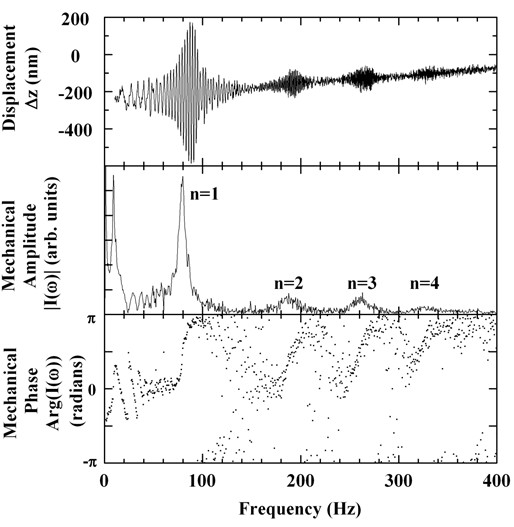
Fig. 1. Example RASOV spectrum of a biological sample, showing the primary (n=1) resonance and the high order harmonics (n=2, 3, 4). Spectra are fitted to a Lorentzian profile according to a simple damped, harmonic oscillator model.
Since the initial development of RASOV, Dr. Oldenburg's lab has been translating the RASOV technique for blood clot analysis, which has led to the development of a portable instrument for clot elastometry called CEMport.
intro page - research - publications - people - open positions
UNC Physics & Astronomy - Biomedical Research Imaging Center - UNC Home