Optical Coherence Imaging Laboratory
Amy L. Josefsberg, Professor
Department of Physics & Astronomy
Biomedical Research Imaging Center
University of North Carolina at Chapel Hill
Blood Clot Elastometry for Diagnosis and Monitoring of Blood Pathologies and Anti-Coagulants
Using the RASOV method and the CEMport instrument, we have performed several studies on the stiffness of blood and plasma clots. First, we studied how fibrinogen and thrombin, the latter of which is an enzyme needed for the clotting process, affects the stiffness of purified fibrin clots (Wu et al, 2013). Because fibrin is the primary constituent that makes up the scaffolding of a blood clot, we showed how elevated levels of fibrinogen cause increase in the clot elastic modulus when spiking whole blood samples ("simulated hyperfibrinogenemia"), as shown in Fig. 1. Importantly, the CEMport provides improved accuracy and precision over that of commercial Thromboelastography (TEG), the latter of which is commonly used to monitor blood clotting times during or after surgery.
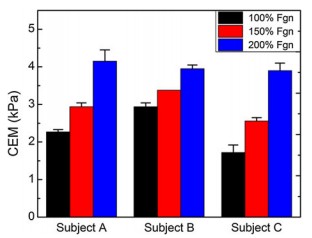
Fig. 1. Clot elastic modulus (CEM) of whole blood from 3 volunteers without (100%) and with (150%, 200%) added fibrinogen to simulate hyper-fibrinogenemia.
One of the most promising potential applications of CEMport is the potential to monitor post-surgical blood coagulation to detect heparin rebound effects. Heparin is often used during surgery as an anti-coagulant, and reversed after surgery to return blood to a normal state of coagulation. However, this reversal is sometimes incomplete, with heparin levels rebounding hours after surgery, which can be dangerous and cause excessive post-surgical bleeding. In Krebs et al, 2015, We found that CEMport is sensitive, via measurement of elastic modulus, to small concentrations of Heparin in plasma (Fig. 2).
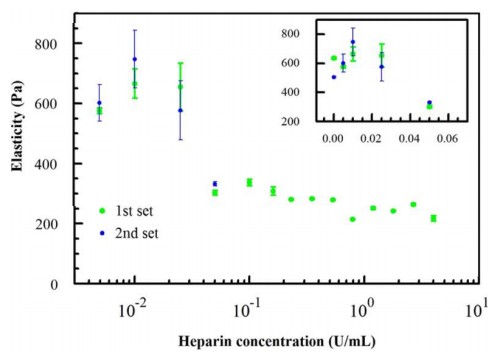
Fig. 2. Elastic modulus of platelet-poor plasma as a function of heparin dose shows a transition at a dose level less than 0.05 U/mL, concentration levels below where coagulation is not normally affected, suggesting that elastic modulus can be more sensitive to heparin rebound than traditional clotting measures.
Going forward, we continue to explore applications where clot elastic modulus as measured by CEMport can provide useful diagnostics or monitoring of blood coagulopathies.
intro page - research - publications - people - open positions
UNC Physics & Astronomy - Biomedical Research Imaging Center - UNC Home